

Choosing Your Career Path, a Practical Guide for Young People and Graduates
Five practical steps to choose your career when you are torn between your studies, your passion and the job market, with real examples.
At a workshop for department supervisors at a Red Sea hotel, I asked the room which situation exhausted them most with their teams. The kitchen supervisor raised his hand and said, half laughing and half tired.
I tell him, son, get this order ready. He says, okay chef. The next day I find nothing done. When I ask him, he says, well, I did not understand exactly when you wanted it.
The whole room laughed, because everyone in it had lived this situation from both sides. Once as the manager who thinks he was clear, and once as the employee who said okay without understanding. Okay sir is one of the most dangerous phrases in Egyptian workplaces, because it ends the conversation before understanding begins.
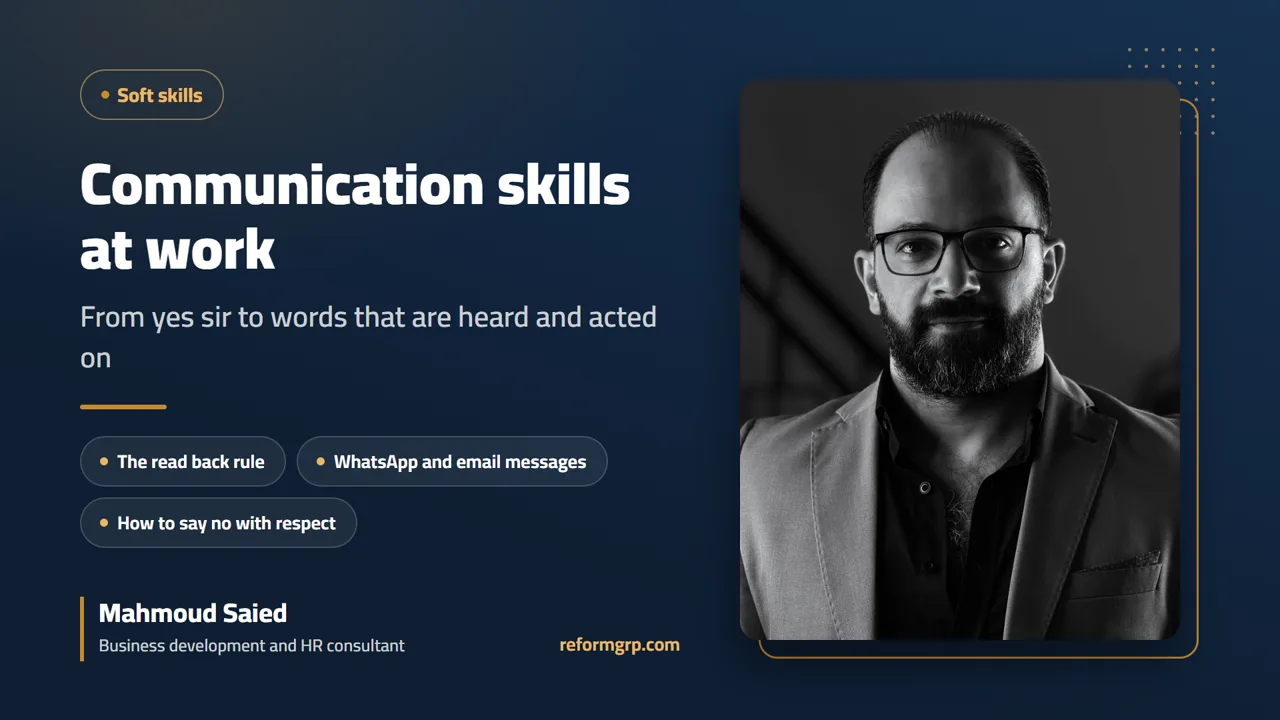
Communication skills at work are not a talent some people are born with, nor just a polite way of speaking. They are a set of small habits you can learn, and in the end they decide whether your words are heard and acted on, or lost between messages and meetings. In this guide I explain the most important of these habits, from communicating with your manager, to written messages on email and WhatsApp, to saying no without losing anyone.
The summary in five points
When I train teams on communication skills at work and analyze problems in the companies I work with, I find three causes that come up almost every time.
The manager assumes the deadline is understood, and the employee assumes it means next week. Each acts on their own assumption, and both are surprised by the result.
Many employees, especially in their first years at work, are afraid they will look slow if they ask. So they say okay and then try to guess. The truth is that a question at the start costs far less than a mistake at the end.
In many of our workplaces it is hard for an employee to tell the manager they did not understand, that the deadline is unrealistic, or that there is a better way. So they stay quiet and put up with it, and the problem shows up later as a delay or a mistake.
The simplest communication tool I have learned, and the most effective, is to repeat what you understood in your own words before you start. Do not just say okay. Say exactly what you understood.
So you need the report on Thursday before two, with last month's sales figures only, without returns. Is that right?
This sentence takes ten seconds, but it exposes any misunderstanding on the spot. If you are a manager, ask your team to do this with you, instead of asking did everyone understand and hearing everyone say yes.
In the days of preparing to open a new hotel on the North Coast, when we were hiring more than 200 people in a single month, this rule is what protected the team from chaos. Every assignment was repeated out loud, and every deadline was written in a message after the meeting.
Your relationship with your manager shapes a large part of your experience at work, and an even larger part of your chances of promotion. These three habits change that relationship completely.
A manager who has to ask how the work is going starts to worry, and a worried manager starts the close follow-up that annoys you. Send a short update at a fixed time, even if the update is that everything is going to plan.
If you know you will be late delivering a task, tell your manager as soon as you know, not on the delivery day. Give the reason briefly, the new expected date and what you suggest to reduce the impact. A manager can handle a problem they know about early, but does not easily forgive a last minute surprise.
Disagreeing with your manager is not rudeness. It is part of your job when your view is based on knowledge. But the way you do it makes the difference. In workshops I teach a four part formula.
I understand the goal is to finish before the holiday. I am worried the team will not have time to check quality. I suggest we deliver the first part on time and push the second by a week. In the end the decision is yours.
Start by showing you understand the goal, then state your concern, then suggest an alternative, then leave the decision to its owner. This formula makes your manager listen to you instead of defending the decision.
In most Egyptian and Gulf companies WhatsApp has become the main work tool, with all its chaos. Messages in the middle of the night, groups with dozens of people, and five minute voice notes. That is why clear writing has become a skill that truly sets you apart.
Compare these two messages.
Good morning sir, I wanted to talk to you about something when you are free.
This message forces your manager to ask what about, then wait, then worry. A clear message says everything at once.
Good morning sir. I need your approval on the new supplier's quote before 4 today so we can make the order. The quote is in the attached file, and it is cheaper than our current supplier for the same quality.
These are some rules I recommend.
An employee who never says no looks cooperative at first, then after a few months becomes an exhausted employee who delivers everything late and at lower quality. The answer is not to refuse, but to return the decision to whoever owns the priorities.
Right now I am working on the sales report and preparing the presentation for the new client, and I should finish them around four. If I start on this request now, which of them would you like me to postpone?
With this sentence you did not refuse, but you made the full picture clear and left the decision to your manager. In most cases they will reorder the priorities or assign someone else. And if the pressure on you is bigger than one extra request, you will find a full plan in the guide to handling work pressure.
We talk a lot about how to speak and forget that half of communication is listening. Active listening means listening to understand, not to reply. Letting the other person finish, asking a question that clarifies what they said, and noticing what they did not say.
Try this exercise in your next meeting. Do not compose your reply in your head while others are talking. Write down the most important point each person made. You will be surprised by how much you used to miss.
Meetings are where your communication skills show in front of everyone at once. When you present an idea or a result to management, start with the conclusion, not the details. Managers are usually busy and want to know in the first thirty seconds what is being asked of them.
They are the skills that help you get your ideas across and understand others clearly at work, including speaking clearly, active listening, professional writing in emails and messages, handling disagreement and presenting to management.
Start by understanding what really matters to them, results, details or speed, then speak in their language. Send regular updates before they ask, record important agreements in writing, and discuss disagreements in private, not in front of the team.
Before the meeting, prepare one point or one question you want to raise, and say it in the first fifteen minutes before the tension builds. With repetition the shyness fades, because confidence comes from practice, not before it.
It is fine if they are short and your manager is used to them, but for important matters it is better to write, because a written message is quicker to read, easier to come back to and records the agreement.
Use the read back. Repeat what you understood and ask whether it is right. This makes you look precise and attentive to detail, not someone who did not understand.
Nobody will credit you for good intentions if the message did not land. Communication at work is measured by what the other person understood, not by what you meant. The good news is that communication skills are among the fastest to improve, because you practice them dozens of times every day.
Start tomorrow with just one habit. Repeat back what you understood before you say okay. Then add a new habit each week and watch how people deal with you change. And if you want to see where communication sits among the other skills the market asks for, read the guide to soft skills.

Business development and HR consultant, and founder of REFORMHRM, the HR division of Reform Group. He writes practical guides for young people and employees on careers, soft skills and handling work pressure.
Five practical steps to choose your career when you are torn between your studies, your passion and the job market, with real examples.
A six-step plan to change fields, transferable skills, and how to explain the move in an interview.
The seven skills employers in Egypt and the Gulf ask for most, and how to develop them and prove them in your CV.
Register for job seeker services, or book a free 30-minute session.