

Digital Transformation and Business Development, a Practical Guide That Starts with Operations
Process improvement, automation, CRM, data security and change management, with a five-stage roadmap.
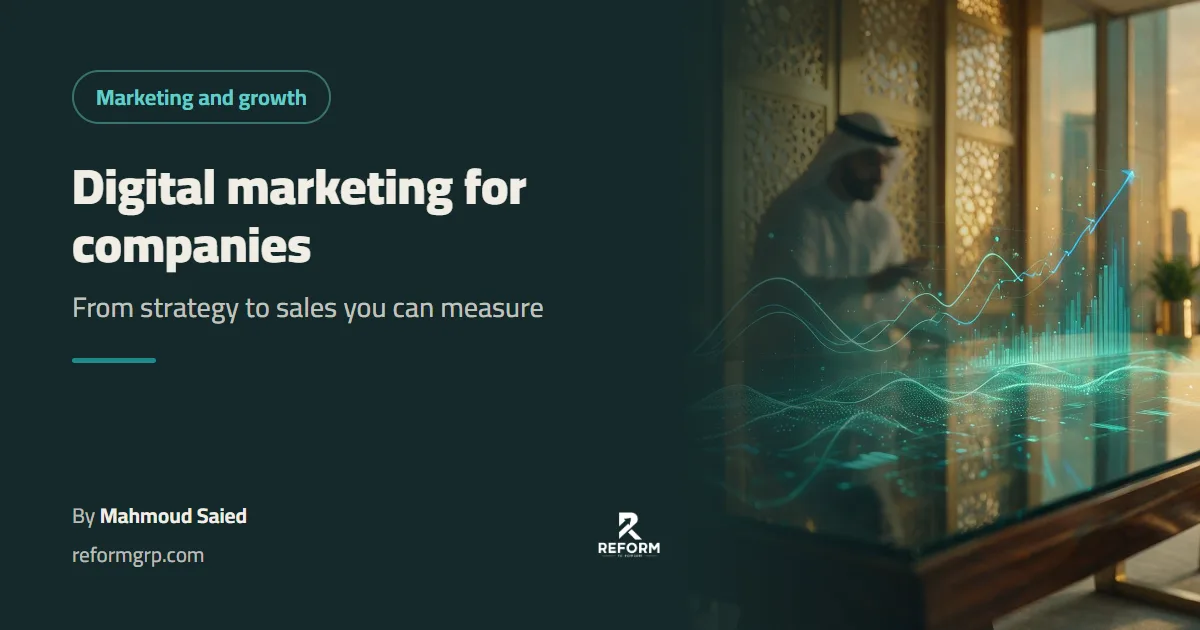
When sales fall, the first thing many business owners do is blame marketing. They change the agency, then the design, then raise the budget, and the result is usually the same. The reason is that digital marketing for companies does not work like a button you press. It works as a connected system that starts with understanding the customer and ends with the decision to buy, and any broken link in it wastes everything before it.
Over the past years I have worked with companies in Egypt, Bahrain and Saudi Arabia across different sectors, from restaurants, cafes and retail to service companies and companies that sell to other businesses. I have learned that the problem is rarely the ad alone. Sometimes it is the message, sometimes the targeting, and very often the step after the ad, when the customer messages you and does not get a convincing reply.
In this guide I lay out the whole picture. What digital marketing for companies actually covers, how to build a digital marketing strategy that fits your market, how to run ad campaigns, content, brand identity and search engine optimization, and how to choose a digital marketing company without repeating an experience that did not work.
The guide in five points
Digital marketing for companies is the use of digital channels, such as social media, search engines, paid ads, the website and messaging, to reach the right customers, turn them into buyers and then into loyal customers. The important word is right, because reaching everyone means reaching many people who do not need you at all.
To make the picture clear, these things are not enough on their own to count as digital marketing in the full sense, even if they are part of it.
In the end, digital marketing for companies answers two questions. How many customers paid, and how much did each of them cost us? Any activity that does not move closer to answering those two questions needs reviewing.
Customers pass four stops before they pay. They see you, then contact you, then talk to your team, then decide. They can be lost at any of these stops. Most companies watch the first stop closely, so they know the views and clicks, and they watch the last when they count sales, but almost nobody watches the third.
A message answered a full day later. An employee who does not know the prices or cannot explain the difference between services. An offer that changes from one person to another. These are not marketing problems but team and system problems, and they are among the most misunderstood parts of digital marketing for companies. Raising the ad budget in this situation is like pouring water into a leaking bucket. You spend more every month and understand less.
Three common decisions make the problem worse instead of solving it. Raising the ad budget while replies are still slow, changing the agency without measuring where the customer gets lost, and hiring a salesperson without training or a clear reply script.
Before any solution, map your customer's journey and ask at every stop how many customers entered here and how many moved on to the next. Where the number suddenly drops, that is where the problem lies. This is exactly what we do in the free diagnosis session, because we work on marketing and HR together, so we see the journey from the ad all the way to the team.
A good marketing plan does not start with where to post, but with who we are talking to. These six elements are what we build any digital marketing strategy on.
A common mistake here is looking for a ready-made marketing plan and applying it as it is. A ready plan may help you understand the general shape, but it does not know your customers, your competitors or your strengths. A plan that does not know these things will spend your budget on assumptions.
Many companies change their logo, colors and uniform, then discover months later that the customers are the same, competition is still on price, and the same question keeps coming up, what makes you different? The reason is that a brand is not a logo. The logo is the signature. The brand is the impression left in the customer's mind, who you are, for whom, and why you and not someone else.
Here is a quick test. Cover your logo on any ad or post of yours, then ask yourself whether the customer would know it is yours. If the answer is no, you have a nice design, but you do not have a brand yet.
A complete brand identity is built in this order.
That is why we see identity as the foundation of digital marketing for companies, because every ad and post either builds on it or undermines it. A small company needs a brand more than a large one, because without a clear difference it leaves the customer nothing to compare except price. A beautiful design without a clear message is like a beautiful ad whose owner nobody remembers.
You may post every day with beautiful designs and well-chosen hashtags, while engagement still comes from the same people, messages are few and new customers come from people you already know. The reason is usually that the content talks about the company, while the customer cares about themselves. We opened, our offer, our team, all of it is about you. Customers stop when they see their own problem.
Three examples show the difference.
Content that sells follows a plan. It defines your audience, their problems, which content answers them and where the reader goes after reading, with a steady posting and engagement schedule. Professional social media management is not only posting. It is answering comments and messages quickly, following what people ask about, and turning those questions into new content that answers them.
No single platform suits everyone, but there are clear patterns in our markets.
The boost post button is not an ad campaign. If all your ads come out of that button, you are probably paying for the wrong thing. An ad delivers what you ask of it. Choose engagement and it brings engagement. Ask for the cheapest message and it brings the people who message most easily, not those most ready to buy.
A real campaign has four parts. A clear objective that matches the result you want, a defined audience built on your actual customers, a message that fits the customer's stage, and measurement of return on investment. Many people do not buy the first time, so you need a complete path known as a funnel, starting with an ad that introduces you, then an ad that returns to them after they engage, then a clear offer for those who are ready.
Managing ad campaigns does not end at launch. A campaign needs almost daily follow-up in its first weeks, constant testing of messages, designs and audiences, and reallocation of the budget according to actual results. A team that launches a campaign and comes back to it at the end of the month leaves a lot of money without real return.
Google ads differ from Meta ads in nature. Google ads reach people searching for you right now with clear intent, while Meta ads reach people who may need you but are not searching yet. A good strategy uses both, each in its place, and splits the budget by the customer's stage and the nature of the product.
If you judge an ad only by its cost per message, the cheapest message may turn out to be the most expensive customer. The most important number is the cost of a customer who actually paid, which you calculate by dividing the ad budget by the number of customers who bought. One ad may bring many cheap messages, then consume your team answering price questions that end in silence. Another brings fewer messages at a higher cost, but a much higher purchase rate, so it is actually the cheaper one.
To make the ad screen customers before bringing them in, make its message clear about who the product is for, point to the price or level, build the targeting on your actual customers, and add a simple screening question in the first reply, such as when do you need the service? That question alone separates the interested from the curious.
An ad stops when the budget stops, but appearing in search results keeps bringing customers for months and years. Search engine optimization is the work that makes your website appear when a customer searches for the service you offer, and it rests on three pillars.
Arabic content has a big opportunity, because many specialist topics still lack deep, useful Arabic content. Whoever starts early and writes well claims the place before the competition. If your business is local, do not neglect your business profile on Google Maps, because it is often the first thing a nearby customer sees. You can read Google's SEO starter guide to understand the basics from the source.
The website itself is a core part of this equation, because a slow or unclear site wastes every effort in content and advertising. We dedicated the guide to websites and apps for companies to it.
Your customer buys from you before buying from your company, especially in services and in the Gulf in particular. A new customer who does not know you personally searches for you before the meeting. If they find an outdated profile whose last post is a holiday greeting, they compare you with others on price and offer only, and your real expertise never enters the calculation.
A professional presence rests on three pillars. The expertise you know better than others, the opinion you hold in your field that others do not say, and the proof from stories and situations in your actual work. Doing it is simpler than it looks. A profile that shows what you solve, not only your title, a personal content plan in your voice, and a posting rhythm you can keep.
Avoid three common mistakes. Posting only the company's achievements so your account becomes a copy of the company's, waiting until you have time, and imitating influencers who are nothing like you. In business services trust travels from the person to the company, and a founder with a clear presence makes it easier to trust the company before the first meeting.
The principles are the same, but the market imposes its details. Any digital marketing company working in the region must know these differences and build on them.
The market is large, competition is fierce and customers are price sensitive, which is why so many messages ask about the price and then disappear. The answer is not hiding the price to get more messages, but an ad message that screens the audience early and a trained reply team that turns the inquiry into a conversation. Facebook and WhatsApp are also still at the heart of the buying journey for large parts of the audience.
The market is huge and diverse, digital spending is high, and the audience is young and always online. Seasons carry great weight, such as Ramadan, the Eid holidays, National Day and Founding Day. Content that works here respects local culture and speaks in a language close to people, with a strong presence on Snapchat, TikTok and X alongside Instagram.
A smaller, more connected market where personal recommendation is very strong and a single bad experience spreads fast. So what you promise in the ad must match what the customer actually lives. Many Bahraini companies, especially restaurants and cafes, also target visitors from Saudi Arabia's Eastern Province, which calls for campaigns designed for two different audiences.
If you are starting fresh or rebuilding your company's digital marketing, this is a practical sequence we often use in the first three months. The idea is to build the foundation before you spend, then test before you scale.
Map the current customer journey in numbers, review the previous accounts and ads to learn what worked and what did not, and define the audience and positioning clearly. Then set up measurement on the website, the ads and WhatsApp, and write the core reply scripts for the team. Do not spend a large budget this month before you know where customers are leaking out.
Launch one or two campaigns with clear objectives, and test more than one message, design and audience. Start a content schedule that answers the real customer questions you gathered in the first month, and check the speed and quality of replies every day, because any gain in the ad is lost if the reply stumbles.
Stop what does not work without hesitating, double the spend on what proves its return, and start retargeting interested people who engaged but did not buy. Then set the content and campaign plan for the next quarter based on the numbers you collected, not on impressions, and choose one main indicator the team is accountable for.
You cannot improve what you do not measure. This is a short table of the numbers we follow at each stage of the customer journey.
| Stage | Question | Indicator |
|---|---|---|
| Sees you | Are we reaching the right audience? | Reach within the target group and cost per impression |
| Gets in touch | Does interest turn into contact? | Number of leads and cost per lead |
| Talks to your team | Does the team handle the inquiry well? | Reply speed and the share of conversations that move to an offer |
| Decides | Do they actually buy? | Closing rate and cost per paying customer |
| Comes back | Do they return and recommend you? | Share of returning customers and long term customer value |
Review these numbers weekly for campaigns and monthly for strategy, and never judge a campaign on three days alone. Judgment comes from numbers, not impressions, and without measurement every decision is a guess.
You tried an agency and paid for several months, then came out with the same question, what did we actually gain? The problem usually started before signing, when there was no clear agreement on what success means or who is responsible for what. Whether you are looking for a digital marketing company, an agency or an independent team, ask these questions before signing with anyone, including us.
Be wary of promises of guaranteed results, of a price quote before anyone asks about your company, and of reports full of numbers without a single figure on sales.
A campaign that brings in customers fails if the team is not ready to receive them, a slow website wastes the ad budget, and without a system to follow up leads, half of them are lost before they become buyers. That is why we do not treat digital marketing for companies as a separate file. At Reform Group we work on four integrated pillars.
If your sales and customer service team is the weakest link, you will find what you need in the guide to HR consulting for companies. And if lead follow-up gets lost between phones and Excel sheets, read about CRM systems in the guide to digital transformation for companies.
We start with a free ninety minute diagnosis session where we review the whole journey from the ad to the team, and you leave with a written summary of recommendations. Then you choose the right starting point for you, a specific project such as a visual identity or a particular campaign, a complete marketing strategy with implementation, or ongoing monthly management of content and ads. We agree clear performance indicators from the start and review them with you regularly.
Send us three lines, your field, the size of your team and what worries you most about marketing right now, and we will set the session date within 48 hours.
Book the free diagnosis session on WhatsApp
You can see the service details on the marketing and growth page, and follow our weekly ideas on Instagram and LinkedIn.
It is the use of digital channels, such as social media, search engines, paid ads and the website, to reach the right customers and turn them into buyers, measuring every step in numbers so the company knows where its budget goes and what it achieves.
A social media manager usually focuses on posting and daily engagement. A digital marketing company works on the whole system, from strategy, identity and content to paid campaigns, search engine optimization and measuring return on investment.
There is no fixed number that suits everyone. The budget depends on your goal, the size of the market, the competition and the value of a customer to you. More important than the size of the budget is knowing the cost of a customer who actually paid, then increasing spend on the channels that prove their return.
Paid campaigns can give early signals within weeks, but they need time to learn and improve. Search engine optimization and brand building build up over months, but their results last much longer.
Good content builds trust, and ads speed up its reach to the right audience. In most cases the two work together. Content gives the ad credibility, and the ad gives the content an audience.
It depends on your audience. Instagram and TikTok are strong in all three markets, Snapchat matters in Saudi Arabia, Facebook is still influential in Egypt, and LinkedIn suits companies that sell to other businesses best. WhatsApp is the channel where most deals in the region close.
When its reports are tied to sales figures, not only likes, such as the number and cost of leads, the closing rate and the cost per paying customer. Agree these indicators before signing and review them together regularly.
Yes. The diagnosis session is free and lasts ninety minutes. We review your company's situation and identify the gaps and opportunities in marketing and sales, and you then receive a written summary of recommendations with no obligation to continue with us. It can be held online from Egypt or the Gulf.

Founder and CEO of Reform Group. For more than ten years he has worked with companies in Egypt, Bahrain and Saudi Arabia on what decides their ability to grow, from teams and HR systems to marketing, digital transformation, and websites and apps.
Process improvement, automation, CRM, data security and change management, with a five-stage roadmap.
WordPress or a ready platform, Flutter apps, online stores, and what drives the cost.
From structure and payroll to recruitment and performance, and how to choose the right partner in Egypt and the Gulf.
A free 90-minute diagnosis session where we understand your business and goals and agree the best starting point with you.