

HR Consulting for Companies, Your Guide to Building a Team That Drives Growth
From structure and payroll to recruitment and performance, and how to choose the right partner in Egypt and the Gulf.
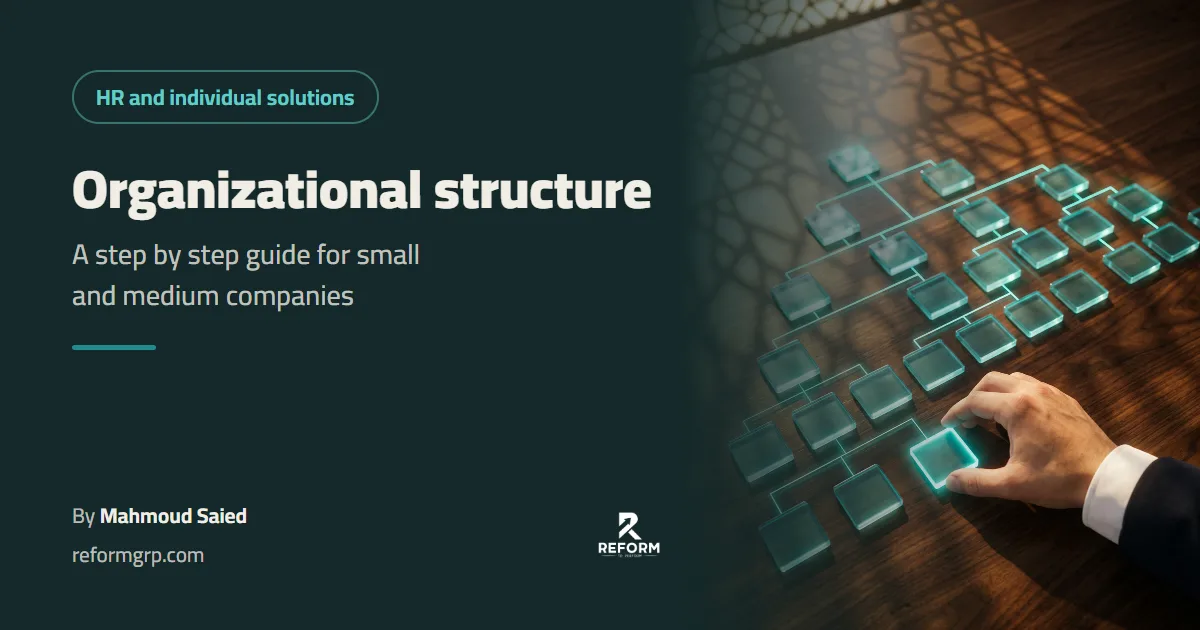
In the first years of any company, the founder is the manager, the accountant, the head of sales and the person who solves every problem, all at once. That is natural while the team is small and the customers are few. But the company grows, headcount rises and the work branches out, while every decision still waits on one person. This is where slowness and confusion begin, and employees feel they do not know whom they report to or exactly what is expected of them.
The answer is not a neat drawing of boxes and lines hung on the office wall. It is an organizational structure for the company built on the work that has to be done, one that states clearly who does what, who reports to whom and who holds the right to decide. At Reform we see a good structure as the first tool that frees the founder from daily detail and lets the company grow without breaking.
In this article we explain when your company needs an organizational structure, the types of structure that suit small and medium companies, the practical steps to build one from strategy through to the authority matrix, and the mistakes that ruin it before it starts, with notes on family businesses and on the market in Egypt and the Gulf.
The article in five points
An organizational structure is the way a company divides work between people and departments, coordinates them and distributes authority and responsibility. The chart people see is only a short picture of deeper decisions, such as where the responsibility of sales ends and that of customer service begins, who approves a discount and who signs a purchase order.
A good structure answers four questions every employee asks, even if only to themselves.
When the answers are missing, everyone fills the gap with their own judgment. Work overlaps in one place and falls between departments in another, and daily disputes become personal instead of being handled as a matter of organization. The structure is part of a wider system that covers pay, hiring and performance, the system we explain in the guide to HR consulting for companies.
There is no single moment when a structure becomes necessary, but there are clear signs. If you find three or more of them in your company, it is time to reorganize.
A distribution company in Cairo, for example, may grow from a small team to dozens of employees within a few years, while the founder still approves every large order, every discount and every hire. The result is that one person's capacity to follow up becomes the ceiling on the growth of the whole company.
There is no structure that is right for every company. The choice depends on the size of the company, the range of its products, and the number of its branches and markets. These are the most common types in small and medium companies.
Similar work is grouped into one department, such as sales, operations, finance and human resources. It is the best fit for most companies at the start, because it is clear, easy to understand and builds specialist expertise inside each department. Its weakness is that departments can close in on themselves, so that only top management sees the whole customer journey.
The company is organized around its branches or product lines, and each branch or product has a manager responsible for its results. It suits a company with branches in more than one city, or one that combines two different activities such as sales and maintenance. Its strength is clear responsibility for profit and loss. Its weakness is that some roles are repeated in every branch, and procedures are hard to standardize across branches.
Here an employee reports to two managers at the same time, the head of the specialist department and the project manager. It usually appears in contracting and consulting companies that work on projects, where a site engineer reports to the project manager on the schedule and to the engineering department on technical standards. It is flexible, but it needs written rules that settle who decides on each matter, or it turns into a constant fight over priorities.
It has few management levels and direct contact between the team and management. It suits startups and small teams in technology, design and education. But it reaches its limits quickly as headcount grows, because the founder or the only manager becomes the point of reference for a large number of people.
This table sums up the comparison between the four types.
| Type of structure | When it suits the company | Main strength | What to watch |
|---|---|---|---|
| By specialized department | One activity and one office, or a few branches | Clear roles and growing expertise | Weak coordination between departments |
| By branch or product | Branches in more than one city or more than one activity | Clear responsibility for results | Repeated roles and differing procedures |
| Matrix | Project based work such as contracting and consulting | Flexible use of expertise | Two reporting lines and fights over priorities |
| Flat | A small team or a startup | Fast decisions and management close to the team | Heavy pressure on the manager as the company grows |
In practice, most mid-sized companies combine more than one type. Support departments such as finance and human resources may be shared across the company, while sales and operations are organized by branch.
These are the steps we follow with companies, and their order matters. Jumping to drawing boxes before the first two steps is the most common reason structures fail.
Ask where you want the company to be in two or three years. Will you open a new branch, enter another market or add a service? Then list the core work that must be done to get there, from winning customers and fulfilling orders to collections, hiring and purchasing. It helps at this point to map the core processes as they actually happen, which we explain in the article on improving operational processes, because a structure that does not serve the processes becomes an obstacle to them.
Once you know the work required, group similar or related tasks into roles. A role here is a description of a set of responsibilities, not the name of a particular employee. One person may hold two roles in a small company, such as accounting and personnel affairs, while one role may need several people in a larger company, such as sales representative. What matters is that each role has a clear purpose, known outputs and indicators to measure it by.
The span of control is the number of people who report directly to one manager. There is no fixed number. The right one depends on how similar the work is, how experienced the team is and how much daily follow-up the manager needs to give. A supervisor in a call center who follows a team doing the same work can lead more people than a manager who follows an accountant, an engineer and a purchasing officer at the same time. The most important rule is that every employee reports to one manager in daily work, even if they cooperate with more than one department.
The job description is what turns a box on the chart into a real job. It covers the purpose of the job, the core tasks, the performance indicators, the authority, the qualifications and experience required, and whom the job reports to and who reports to it. You can start from the free job description template and adapt it to your company. Write the description together with the job holder and their manager, because they know the details of the daily work best.
Many companies skip this step, although it is the heart of the structure. A delegation of authority matrix is a table that sets, for each type of decision, who proposes, who reviews, who approves and who must be informed. Examples of decisions that need written limits are customer discounts, purchase orders, hiring and termination, raises, spending outside the budget and contracts with suppliers.
A clinic in Manama, for example, may decide that the clinic manager approves doctors' schedules and routine medical purchases, while the founding partner approves any new contract with an insurance company and any hiring of a doctor. Once these limits are written down, employees stop waiting for the founder on every decision, and the founder knows exactly what will reach them.
A good structure does not only describe the company today. It shows its shape at the next stage. Draw two versions, the current structure and the target structure in a year or two, and set which roles will be added and when, and which current employees could be prepared for them. The structure then becomes a tool for planning hiring, training and the budget, not a document forgotten in a drawer.
Start by explaining the new structure to the managers before anyone else, then hold one to one meetings with every employee whose role or manager has changed, and explain the reason before the details. After that, update contracts, employee files and system permissions, such as who approves requests in the accounting system or the HR system. In the first months, check whether decisions really flow through the new lines, or whether everyone still goes back to the founder out of habit.
We have seen many structures that look logical on paper and then stall in practice. These are the most common mistakes.
In family businesses the role of ownership overlaps with the role of management, and family members may hold management positions because they are family, not because they are the best fit. This does not mean keeping the family out of the company. It means separating three circles: ownership, represented by the partners or a family council, top management that leads the company, and executive roles filled on merit.
In practice we suggest three steps: family members who work in the company follow the same job descriptions and performance indicators as everyone else, clear rules are written for how the next generation joins the company, and each person's authority is set in the authority matrix according to their role, not their standing in the family.
As for the founder, their role changes as the company grows. At first they are the main doer, then they become a leader of managers, then they focus on strategy, major relationships and business development. The structure is what makes this transition possible, because it moves daily decisions to the people who should take them. The transition is hard on many founders, so it is better done gradually, by delegating one type of decision and watching the results before delegating the next.
The same principles apply in Cairo, Riyadh and Manama, but some details recur in the region and deserve attention.
Once the structure is settled, the next step is to build job grades and a salary scale based on jobs, not people. A real estate company in Jeddah cannot set fair salaries before it knows which jobs it has and how much each one weighs.
We start with a free ninety minute diagnosis session where we review how your company is organized today, who actually takes the decisions and where work stalls between departments. You then receive a written summary of the gaps and the suggested first steps, and you can find out more on the free diagnosis session page.
If you decide to continue, we build the target structure, the job descriptions and the authority matrix with you, and apply them with your team in stages.
Book the free diagnosis session on WhatsApp
For more details, visit the HR consulting page, or go back to the guide to HR consulting for companies.
It is the way a company divides work between people and departments and sets reporting lines and limits of authority, so that every employee knows their role, their manager and the decisions they own.
When every decision goes back to the founder, when disputes over responsibilities keep repeating, or when the company is preparing to open a branch or enter a new market. It is not tied to a set number of employees, but to how complex the work is.
A structure built on specialized departments suits most companies at the start because it is clear and simple. As the company expands into branches or different activities, it can be combined with organizing by branch or product.
It is a table that sets, for each type of decision such as discounts, purchasing, hiring and spending, who proposes, who reviews, who approves and who is informed. It is what turns the structure from a drawing into a working system.
At least once a year, and with every major change such as opening a branch, adding an activity or a change in top management.
Yes. The diagnosis session is free and lasts ninety minutes. We review your company's situation and identify the gaps and opportunities, and you then receive a written summary of recommendations with no obligation to continue with us. It can be held online from Egypt or the Gulf.

Founder and CEO of Reform Group. For more than ten years he has worked with companies in Egypt, Bahrain and Saudi Arabia on what decides their ability to grow, from teams and HR systems to marketing, digital transformation, and websites and apps.
From structure and payroll to recruitment and performance, and how to choose the right partner in Egypt and the Gulf.
A practical guide to operational process improvement, from mapping how work really runs and measuring waste to redesigning it, writing an SOP and automating.

Strategy, identity, content, ad campaigns and SEO, and how to choose a marketing partner that measures results in sales.
A free 90-minute diagnosis session where we understand your business and goals and agree the best starting point with you.